
GRIGIO COLLEMANDINA
BEST-SELLERS
2024-04-09
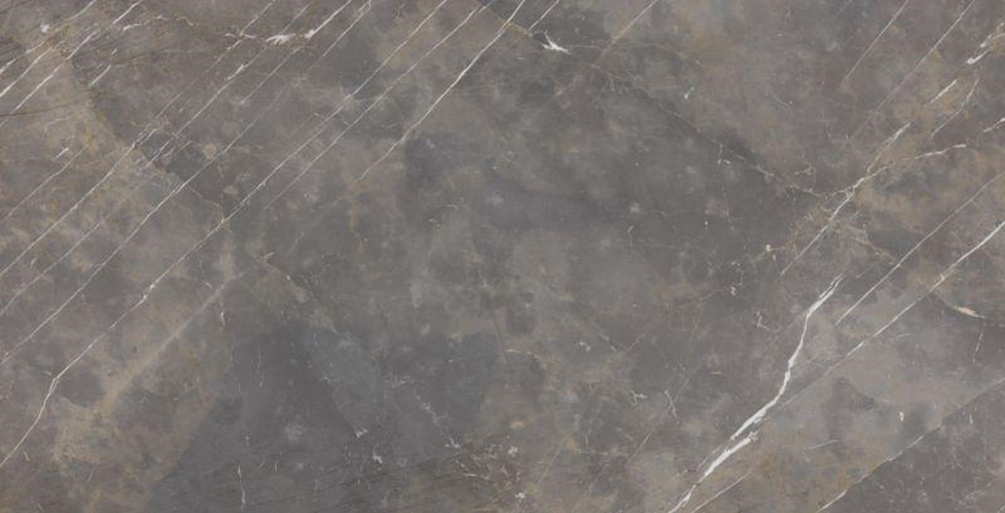
High compactness, excellent polishing properties, and an intense grey background with brown inclusions interwoven with white and golden veins: these are the distinctive features of Grigio Collemandina marble, a limestone from Central Italy with a… red past.
Type: MARBLE
Finishes: POLISHED, HONED, BRUSHED
Colour: : GREY WITH WHITE VEINS AND SHADES
From red to grey: the evolution of Collemandina
Originally, the material quarried in the heart of Garfagnana stood out for its intense ruby-red colour, marked by a dense network of white and grey veins.
Rosso Collemandina, technically classified as a limestone breccia, has been a symbol of prestige since it was first quarried. Its warm tones and compact structure made it the perfect material for sacred furnishings and grand noble palaces, where it was used for flooring, cladding, and highly decorative interior works.
However, quarrying activity over recent decades has revealed the natural transformation of the Tuscan deposit: deeper excavation has led to a gradual depletion of the iron oxides that gave this material its red colour.
This is why Rosso Collemandina has now become a material of rare availability. In its place, today’s quarries offer a different yet elegant chromatic variation: Grigio Collemandina marble. This stone features a very intense anthracite-grey base, sometimes shifting towards warm tobacco or brown shades.
Geological origin and geographical origin of Grigio Collemandina
This natural stone comes from Tuscany, more precisely from Villa Collemandina, a municipality located in the Garfagnana area, in the province of Lucca.
It lies at the foot of imposing rocky outcrops dating back to the Early Jurassic period, approximately 190–200 million years ago and belonging to the geological complex of the Tuscan Nappe.
From a scientific point of view, the rock is a cemented limestone breccia formed in an ancient marine platform environment. The sedimentation of calcareous muds, accompanied by the presence of ammonites, gave rise to the typical fossil inclusions still visible in the slabs today as elegant spiral geometries.
The characteristic ruby colour of Rosso Collemandina is due to the presence of iron oxides and hydroxides, such as hematite and limonite, which infiltrated the sediments during diagenesis and tectonic compression processes.
In the case of Grigio Collemandina, the chromatic variation towards anthracite and tobacco tones reflects a different mineral concentration and lower oxidation, while maintaining the same veined structure as Rosso Collemandina.
Elegance and resistance: the main technical and aesthetic characteristics of Grigio Collemandina
Grigio Collemandina marble is a dolomitized limestone breccia that stands out in the stone sector for its extraordinary compactness.
From a technical point of view, it has a very low water absorption coefficient, around 0.08%, a feature that makes it particularly resistant to frost and wear. This makes it suitable not only for luxury interiors, but also for structural applications such as stairs and thresholds.
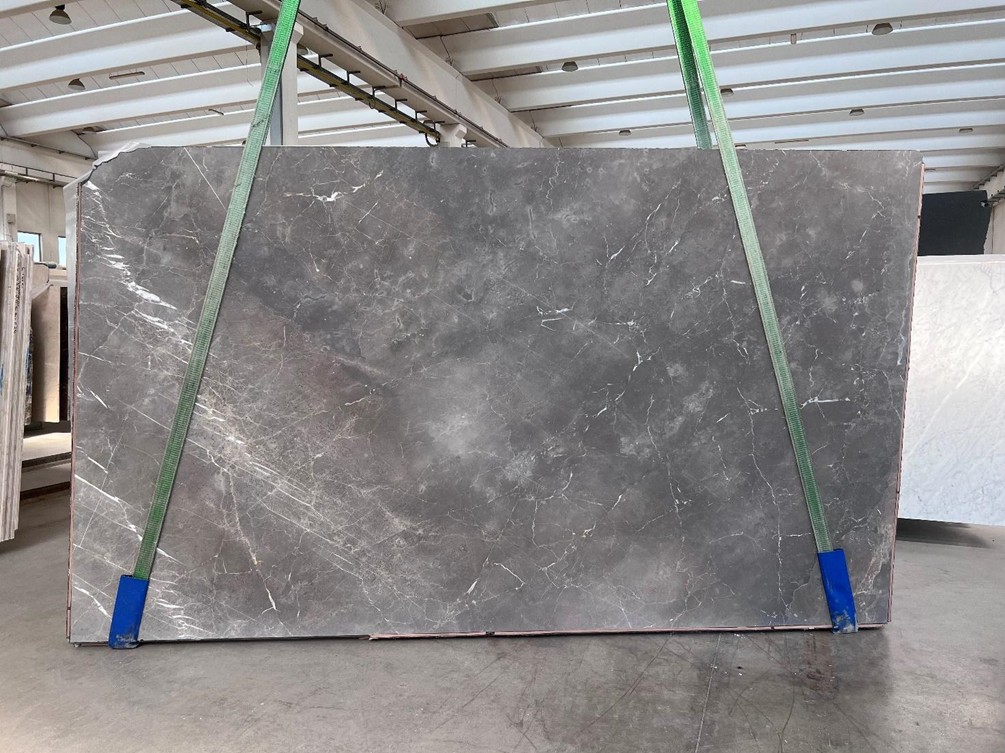
The technical characteristics of this elegant marble also include excellent compressive and flexural strength, as well as high resistance to wear and foot traffic.
Below are the main technical characteristics of Grigio Collemandina marble:
| STANDARD | PROPERTY | UNIT | AVERAGE VALUE | STD. DEV. |
| EN 13755-08 | Water absorption at atmospheric pressure | % | 0.08 | 0.04 |
| EN 1936-07 | Apparent density | kg/m³ | 2700 | 5.2 |
| EN 1936-07 | Open porosity | % | 0.2 | 0.14 |
| EN 12372-07 | Flexural strength under concentrated load, natural state | MPa | 17.3 | 5.5 |
| EN 12371-03 | Flexural strength after 48 freeze-thaw cycles | MPa | 16.9 | 8 |
| EN 1926-07 | Compressive strength | MPa | 94 | 40.9 |
| EN 14231-04 | Slip resistance, honed finish, dry | USRV | 62 | 3.2 |
| EN 14231-04 | Slip resistance, honed finish, wet | USRV | 30 | 3.1 |
Recommended processing and finishes
The versatility of Grigio Collemandina is best expressed through different finishes, such as:
- mirror polishing, a classic process that enhances its chromatic depth and makes the white veining extremely sharp;
- honing and brushing, which give the stone a matt appearance, as well as a homogeneous and silky surface, ideal for contemporary and minimalist design projects.
Because they further emphasize the chromatic beauty and intense tone of the material, polished and honed finishes are the most commonly used
The main applications of use of Grigio Collemandina
Collemandina marble was already appreciated and widely used in the past, when its typical colour was ruby red. Its presence in numerous churches, balustrades, floors, columns, and sophisticated wall claddings in Rosso Collemandina testifies to the value that has always been attributed to this material.
Thanks to its extraordinary resistance, this stone was at the heart of local architecture. The village of Sassorosso, an ancient and perfectly preserved settlement, owes its name precisely to the rock on which it stands and with which it was built, still offering today a visual testimony of this heritage.
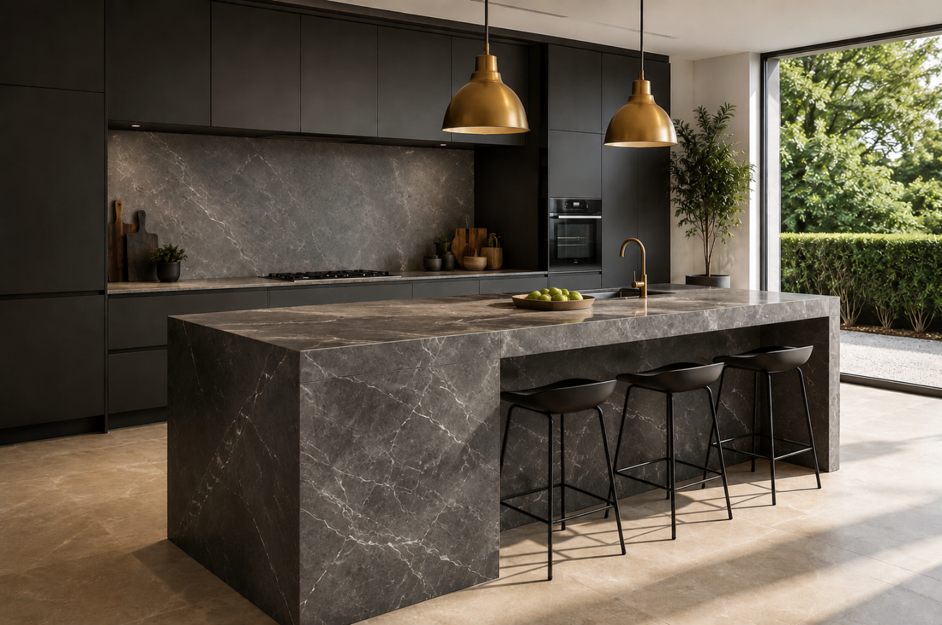
Today, the grey-brown tone of Collemandina marble makes it an extremely versatile material for high-end architecture, suitable for flooring and cladding in both classical and contemporary buildings.
Characterized by high compactness and polishing properties, it is ideal for enhancing the elegance and beauty of floors, large surfaces, and luxury finishes.
In particular, its veined structure is perfectly suited to bookmatch installation: the mirrored arrangement of the slabs makes it possible to create natural geometric patterns and hypnotic symmetries, transforming walls and floors into true works of visual art.
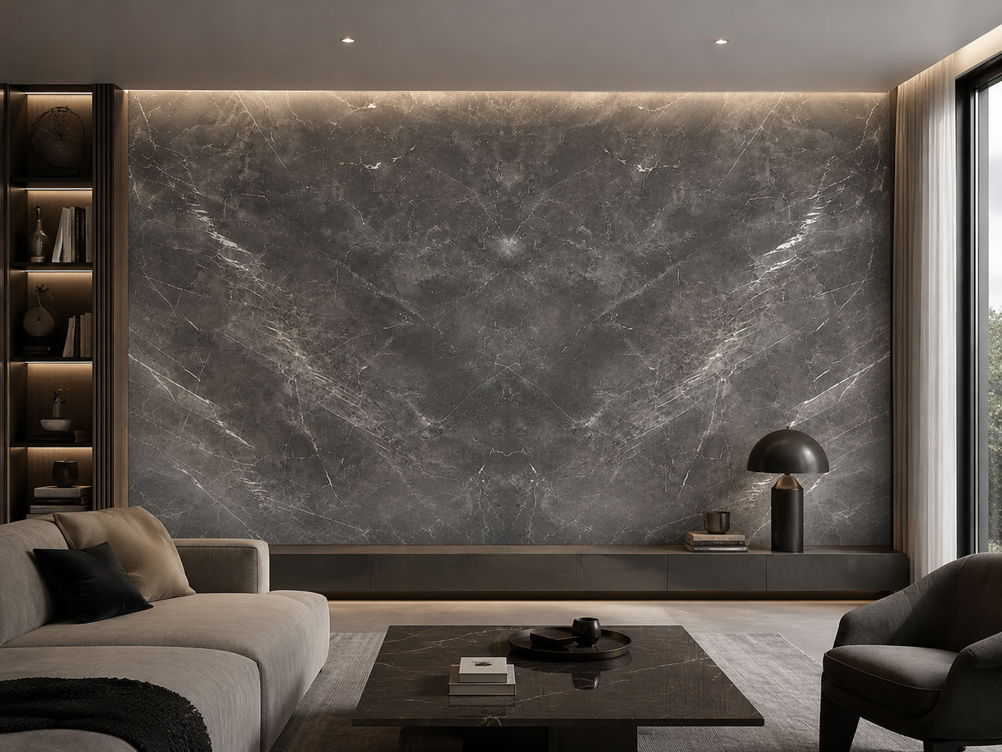
Its whitish and golden veins make it perfect for adding an elegant and contemporary touch to interior and design projects.
Grigio Collemandina at Alberti & Alberti
At Alberti & Alberti, we manage every stage of natural stone processing, from selection to finishing, providing consultancy and materials to architects, stone fabricators, retailers, contractors, distributors, construction companies, retailers, and other B2B professionals.
We do not supply private customers.
Alberti & Alberti warehouses offer a wide assortment of Grigio Collemandina slabs in different sizes, thicknesses, and finishes.
Or contact us for the production of slabs on request.
FAQ about Grigio Collemandina Marble
- What type of stone is Grigio Collemandina and where is it quarried?
From a petrographic point of view, Grigio Collemandina is a dolomitized limestone breccia dating back to the Early Jurassic period. It is quarried exclusively in Tuscany, in the Garfagnana basin, province of Lucca, in the municipality of Villa Collemandina. It is the natural geological evolution of the famous Rosso Collemandina, retaining the same compact structure and physical-mechanical properties, but with a different mineral saturation that shifts towards grey tones.
- What are the differences between Rosso Collemandina and Grigio Collemandina?
The main difference is purely chromatic and is determined by the concentration of iron oxides in the deposit. While Rosso Collemandina, now extremely rare, features a ruby-red background due to strong oxidation, Grigio Collemandina stands out for its anthracite or tobacco-brown base.
- Is Grigio Collemandina resistant? What are its technical properties?
Yes, it is an extraordinarily compact and resistant material. It has excellent compressive and flexural strength. In addition, thanks to its very low water absorption coefficient, equal to 0.08%, it offers high resistance to frost and wear from foot traffic. These characteristics make it ideal for high-traffic flooring, stairs, and complex cladding applications.
- How is Grigio Collemandina used in interior design?
It is frequently chosen for luxury flooring, vertical cladding, and furnishing details such as tables and vanity tops. Its veined structure makes it perfect for bookmatch installation, where mirrored slabs create unique natural geometries. It is widely used both in minimalist and modern interior design and in the restoration of historic buildings.
- Does Grigio Collemandina marble require special maintenance?
As a natural limestone-based stone, it can be sensitive to acidic substances such as lemon, vinegar, or aggressive detergents. Professional water- and oil-repellent protective treatments, together with regular cleaning using pH-neutral soaps, help preserve its shine over time.