
CEPPO DI GRÉ
BEST-SELLERS
2024-10-09
The Ceppo di Gré is an Italian natural stone characterised by its typical grey colour and unmistakable conglomerate appearance, formed by clasts of different sizes in shades ranging from light to dark grey.
Originating from Lombardy and deeply connected to Milanese architectural tradition, Ceppo di Gré has been used for centuries for flooring, cladding and architectural elements. Today, it is particularly appreciated by architects and designers for its contemporary appearance, versatility and excellent technical characteristics.
Type: MARBLE
Finishes:POLISHED, HONED
Colour: GREY BACKGROUND WITH CLASTS OF VARYNG SIZES, LIGHT GREY/DARK GREY.
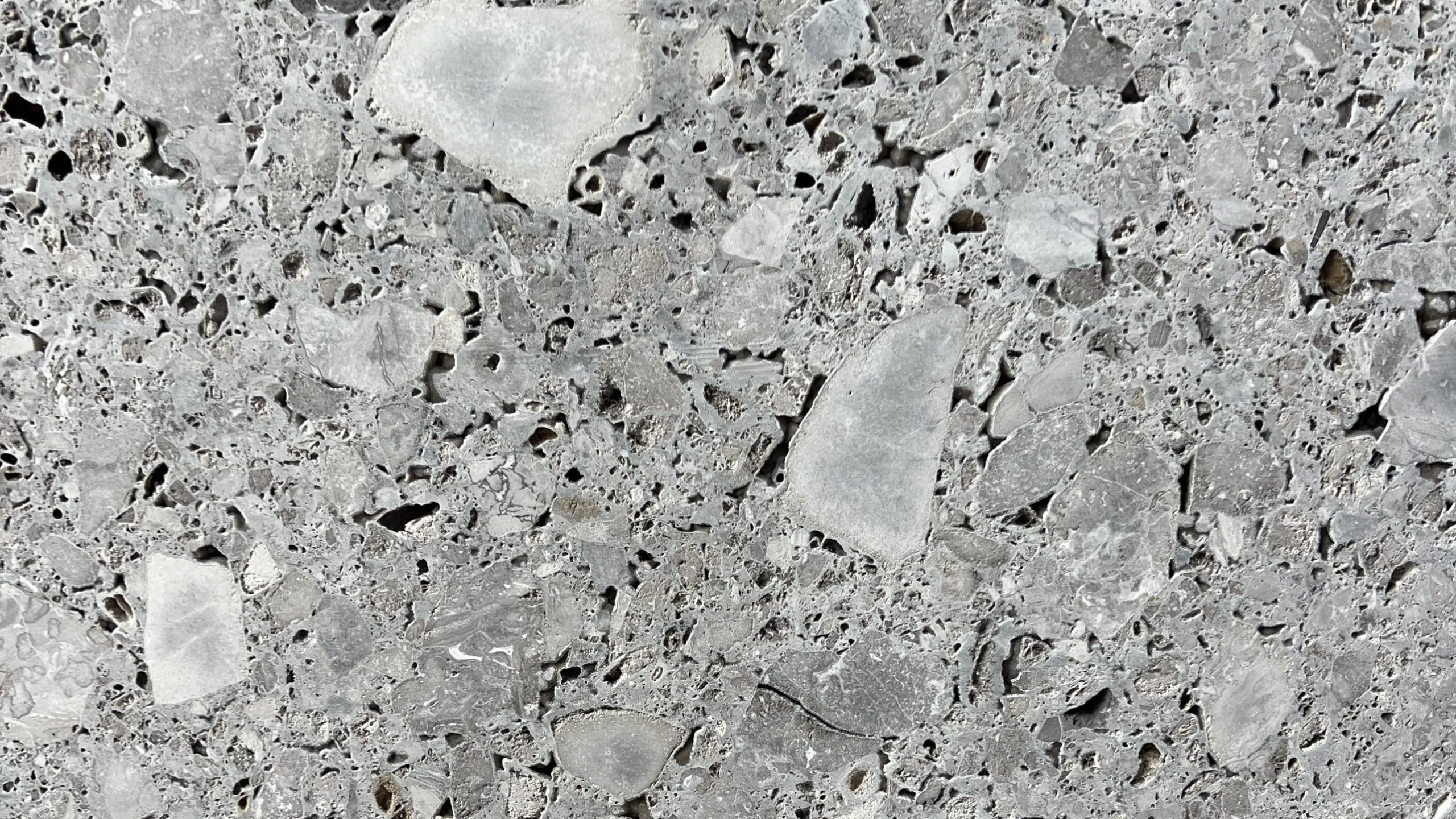
Ceppo di Gré, a young stone: its geological origin
The term “ceppo” identifies several types of stone typical of Lombardy, differing in origin, structure, grain size and colour. For this reason, the term “ceppo” is generally accompanied by the name of the area where the stone originates.
Among the best-known Lombard varieties is Ceppo di Gré, also known as Ceppo del Lago d’Iseo, a sedimentary stone that is relatively young from a geological point of view.
Ceppo di Gré is classified as a dolomitic breccia and consists of rock fragments, known as clasts, naturally cemented together.
Its formation is linked to the accumulation of debris originating from the slopes of Monte Clemo. Over time, natural cementation processes consolidated these materials, transforming them into a compact and resistant rock.
The result is the distinctive structure that makes natural Ceppo di Gré immediately recognisable: a grey surface composed of fragments of different sizes and shades, making every slab unique.
Extraction methods and areas of Ceppo di Gré
Ceppo di Gré is quarried in Lombardy, on the Bergamo side of Lake Iseo, in the Gré area at the foot of Monte Clemo.
Historically, different types of “ceppo” were also quarried along the Adda and Brembo rivers and were widely used in Lombard architecture.
The extraction of Ceppo di Gré in the Lake Iseo area began at the end of the 19th century. Initially, quarrying took place in open-pit quarries, while from the 1990s onwards extraction progressively moved underground.
Today, modern extraction technologies are used to obtain the blocks, which are subsequently selected and transformed into Ceppo di Gré slabs for architecture and interior design.
Technical and aesthetic characteristics
Ceppo di Gré has a predominantly grey-blue colour and a structure characterised by clasts of varying sizes, with shades ranging from light to dark grey.
Despite its visually heterogeneous appearance, the composition of the stone is relatively homogeneous and consists mainly of carbonate and dolomitic components.
Its combination of aesthetics, resistance and good workability makes Ceppo di Gré suitable for numerous indoor and outdoor applications.
It can be used for:
- indoor and outdoor flooring;
- wall cladding and façades;
- stairs and steps;
- bathrooms and shower cladding;
- kitchen worktops and countertops;
- pool surrounds;
- window sills and thresholds;
- architectural elements;
- tables, washbasins and solid-stone design elements.
Its mechanical resistance and durability have made it a popular architectural material for centuries, including for outdoor applications exposed to weather conditions.
One of the most interesting characteristics of Ceppo di Gré for outdoor use is its resistance to weather conditions.
The particular structure of the stone features macroscopic porosity that contributes to its distinctive appearance. When properly selected, processed and installed, the material is suitable for outdoor flooring, cladding, façades, stairs and other architectural elements.
For this reason, Ceppo di Gré has been used for centuries in numerous buildings and public spaces and continues to be chosen for contemporary architecture.
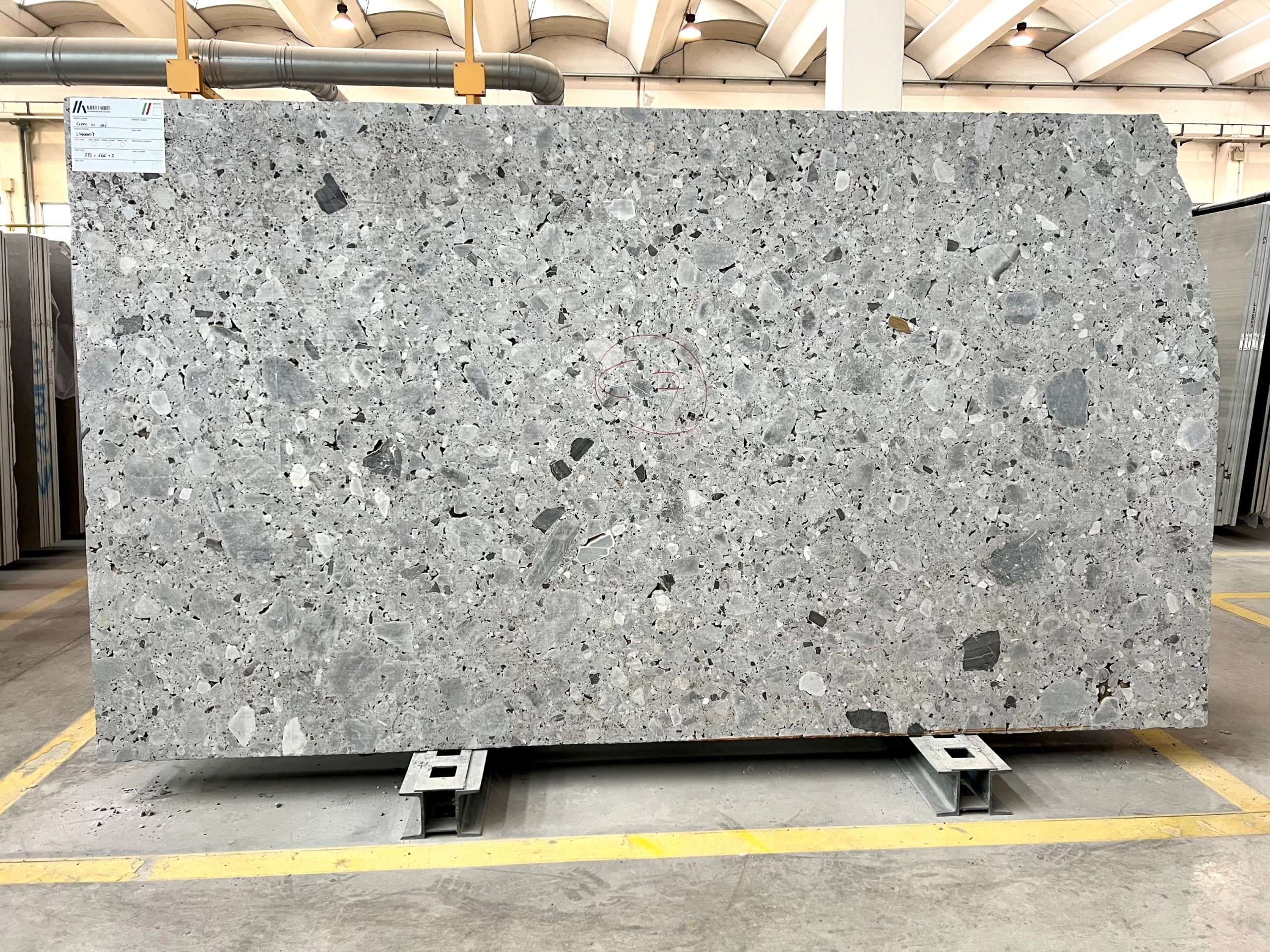
The main technical characteristics of Ceppo di Gré are:
| STANDARD | U.M. | VAL. MEDIUM |
| Coefficient of imbibition | % | 2.43 |
| Thermal expansion mm/°CE-6 | mm/°CE-6 | 9.3 |
| Apparent density | KG/m3 | 2478 |
| Wear resistance | % | 0.32 |
| Flexural resistance | Mpa | 6,3 |
| Resistance to compression | MPa | 54 |
| Compressive strength after frost cycles | Mpa | 54 |
Natural Ceppo di Gré or Ceppo di Gré-effect porcelain stoneware?
In recent years, the distinctive appearance of Ceppo di Gré has been reproduced in numerous industrial products, particularly Ceppo di Gré-effect porcelain stoneware.
However, it is important to distinguish these products from natural Ceppo di Gré stone.
Authentic Ceppo di Gré is a stone formed naturally over time: every slab features a different distribution of clasts, colour variations and unique surface characteristics.
In porcelain stoneware, on the other hand, the Ceppo di Gré effect is achieved through an industrial reproduction of the stone’s texture.
Natural stone also allows for numerous surface treatments and finishes and can be processed in different thicknesses or transformed into three-dimensional and solid-stone elements.
For projects where materiality, uniqueness and authenticity are essential, natural Ceppo di Gré therefore offers very different design possibilities compared with its artificial imitations.
Below are the main differences between artificial products and Ceppo di Gré stone:
| ARTIFICIAL PRODUCTS | CEPPO DI GRE’ (NATURAL STONE) |
| Possible thicknesses 6 or 12 mm | Any thickness achievable |
| They don’t resist to frost | Frost resistance |
| Limited surfaces | Multiple finishes such as natural cleft |
| They can’t be filled | Fill with mastic or cement |
Ceppo di Gré in architecture
The connection between Lombard “ceppo” stones and architecture dates back centuries. These stones have long been used in Milan and other Lombard cities for walls, flooring, columns, cladding and decorative elements.
During the 20th century, Ceppo di Gré became particularly widespread in Milanese architecture, becoming one of the city’s most representative materials.
One of the best-known contemporary examples is the Via Roentgen building of Bocconi University in Milan, designed by Grafton Architects and inaugurated in 2008. The stone was chosen for the building’s exterior cladding, giving a contemporary interpretation to a material deeply rooted in Milanese architectural tradition.
Today, Ceppo di Gré is used in residential, commercial and public projects worldwide. Its neutral colour and distinctive pattern of clasts make it particularly suitable for both contemporary architecture and restoration projects.
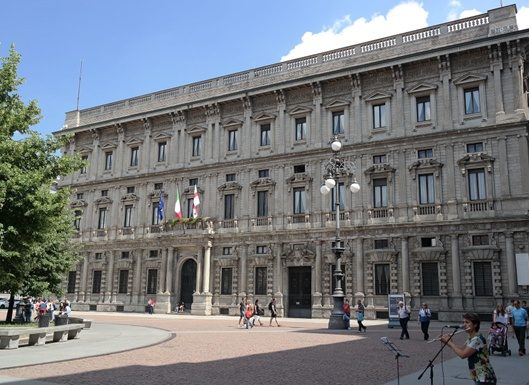
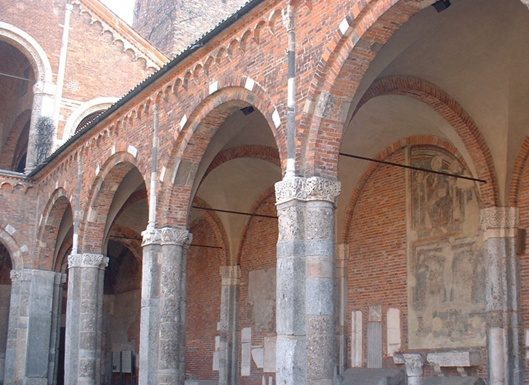
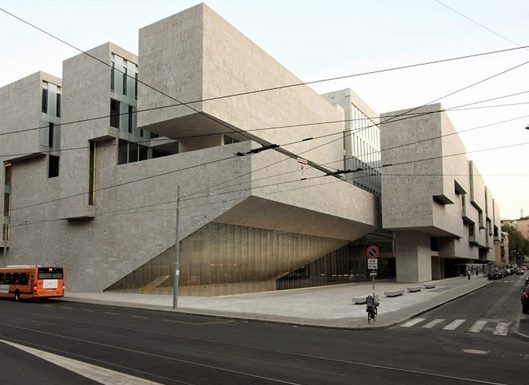
Today, Ceppo di Gré is used in underground stations and skyscrapers around the world, shopping centres and convention centres, museums and hotels. Thanks to its modern appearance and excellent workability, it is now used in both public spaces and private residences for indoor and outdoor flooring, stairs, cladding, pool surrounds and solid-stone design elements such as washbasins.
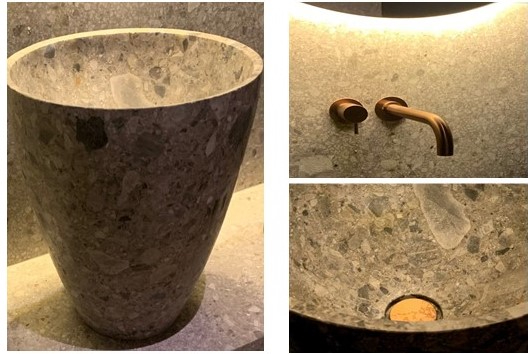
Finishes and processing of Ceppo di Gré
Thanks to its excellent workability, Ceppo di Gré slabs can be processed with numerous surface finishes.
The main finishes include:
- honed, for a uniform and contemporary surface;
- bush-hammered, particularly suitable for outdoor applications;
- sandblasted, for a more textured surface;
- brushed, to enhance the natural structure of the stone;
- waterjet, to create distinctive surface effects.
Ceppo di Gré can also be processed open-pore, leaving the stone’s natural cavities visible for a more textured and rustic appearance.
Alternatively, the slabs can be resin-filled, closing the surface cavities to create a smoother and more uniform surface suitable for applications such as kitchen worktops, tables, bathrooms and other furnishing elements.
The choice of finish therefore depends on the desired aesthetic effect and the intended application.
Ceppo di Grè at Alberti e Alberti
Alberti & Alberti has been processing and supplying Ceppo di Gré for over 10 years, selecting blocks and slabs for architecture and interior design projects in Italy and abroad.
Thanks to long-standing relationships with specialised suppliers, we can guarantee a continuous supply of Ceppo di Gré and careful material selection.
Slab cutting and the main finishing processes are carried out in-house using our own machinery, allowing us to directly control the quality of both the material and the finishes.
We stock Ceppo di Gré slabs in different thicknesses, dimensions and finishes, with the possibility of carrying out specific processing according to project requirements.
Alberti & Alberti operates exclusively in the B2B sector, supplying Ceppo di Gré to architects, stone fabricators, retailers, contractors, distributors, construction companies and other stone industry professionals. We do not supply private customers directly.
A wide selection of Ceppo di Gré slabs in different sizes, thicknesses and finishes is regularly available at Alberti & Alberti warehouses. Check the availability of Ceppo di Gré slabs in real time or contact us for made-to-order requirements.
Or contact us for further information.
FAQ
- Is Ceppo di Gré a marble?
In the commercial stone sector, Ceppo di Gré is often included in the category of marble and ornamental natural stones. Geologically, however, it is not a metamorphic marble: it is a sedimentary dolomitic breccia, consisting of rock fragments naturally cemented together.
- What colour is Ceppo di Gré?
The characteristic colour of Ceppo di Gré is grey, with shades that may tend towards blue-grey. Its surface features lighter and darker clasts of varying sizes, creating the stone’s typical conglomerate appearance.
- Is Ceppo di Gré suitable for outdoor use?
Yes. Thanks to its resistance and durability, Ceppo di Gré can be used outdoors for flooring, cladding, façades, stairs and other architectural elements. The finish should be selected according to the specific application and project requirements.
- Can Ceppo di Gré be used in kitchens?
Yes. Ceppo di Gré can be used for kitchen worktops, islands, backsplashes and other furnishing elements. For these applications, it can undergo specific treatments such as filling and honing, depending on the desired aesthetic and technical result.
- What is the difference between natural Ceppo di Gré and Ceppo di Gré-effect porcelain stoneware?
Natural Ceppo di Gré is genuine stone, meaning that every slab has different clasts, shades and characteristics. Ceppo di Gré-effect porcelain stoneware is an industrial product that graphically reproduces the appearance of the stone. Natural stone also offers greater possibilities in terms of processing, thicknesses and solid-stone elements.
- What thicknesses are available for Ceppo di Gré?
Ceppo di Gré slabs are available in different thicknesses depending on stock and project requirements. Alberti & Alberti regularly stocks slabs in the most commonly requested thicknesses and can evaluate specific thicknesses or processing upon request.